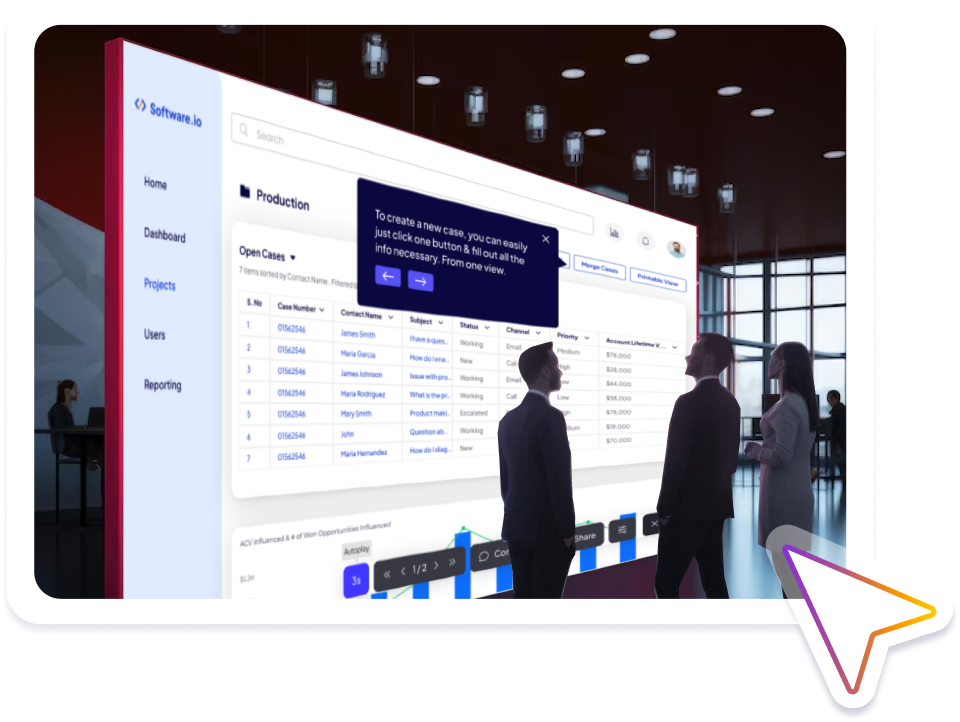



1. The Three-Phase Event Demo Strategy
Interactive demos support the entire event cycle:
Before the Event
- Include demo links in pre-event email campaigns to registered attendees
- Align demo messaging with the event theme or keynote topics
- Use demos to schedule booth meetings with high-priority prospects
During the Event
- Run self-serve demos on booth screens to attract and engage passers-by
- Use micro-demos in 1:1 conversations to tailor the pitch to individual needs
- Deliver stage presentations with fail-safe, polished demo experiences
After the Event
- Send personalized demo follow-ups based on booth interactions and engagement data
- Guide leads to next actions: sales meetings, deeper demos, or internal sharing
- Retarget non-converters with additional demo content tied to event themes
Try Our Add-Ons to increase your demos’ engagement and interactivity.
2. On-Booth Self-Serve Demos
Design for Walk-Up Traffic and Lead Capture
Self-serve booth demos must work with or without staff attention, compete for eyeballs in a noisy environment, and capture lead data while delivering immediate value.
Keep demos short
Target 5-8 screens with 10-15 total interactions. Attendees may only engage for 30-90 seconds.
Use autoplay mode
Enable Autoplay to attract passers-by with movement. Demos auto-advance through key screens, with optional interaction points for engaged viewers.
Auto-restart after inactivity
Configure demos to loop back to the beginning after 60-90 seconds of inactivity, ensuring a fresh experience for each new viewer.
Lead with Choose Your Own Journey
Open with role, industry, or use-case selection to personalize immediately, segment booth traffic, and collect qualification data even from brief interactions.
Lead Capture Strategy
Events are fundamentally about capturing contact information. Structure booth demos to maximize data collection while maintaining engagement.
Strategic Lead Form Placement:
Gate at entry
Require contact info before demo access (best for high-traffic booths prioritizing data quality over volume)
Mid-demo forms (recommended)
Let visitors explore 2-3 screens, then gate the rest with "Enter your email to continue and get this demo sent to you" (balances engagement with lead capture)
End-screen capture
Deliver full value first, then capture details via CTAs like "Get this demo in your inbox" (best for building trust and capturing high-intent completers)
Demoboost Implementation:
- Enable Autoplay and looping mode for continuous play
- Configure Choose Your Own Journey entry screens
- Place in-demo lead forms at strategic points
- Deploy floating CTAs for persistent engagement
- Apply Variables for event-specific messaging
- Add Video Narration/Voiceover for audio-guided experiences when booth staff are unavailable or for visitors who prefer listening over reading
- Set up custom ending screens with post-form CTAs
3. Stage Presentations & Keynotes
For scheduled sessions, breakouts, or keynote demos:
Pre-session lead capture
For pre-session lead capture, use a QR code linking to a gated Demoboost demo. Attendees scan to access the demo on their devices and submit their details through in-demo lead forms. While Demoboost doesn’t generate QR codes natively, its shareable URLs work seamlessly with external QR tools to capture leads directly into the demo and CRM.
Optimize for large displays
Adjust screen layouts and font sizes for visibility in large venues. Test demos on projectors or LED walls before the event.
Use Demoboost Tours, not live product
Avoid connectivity issues, authentication problems, and unexpected UI changes. Tours provide a stable HTML clone of your product that works reliably offline—ensuring smooth, glitch-free presentations.
Enable self-exploration
Let attendees explore the same demo independently on their devices during or after the presentation.
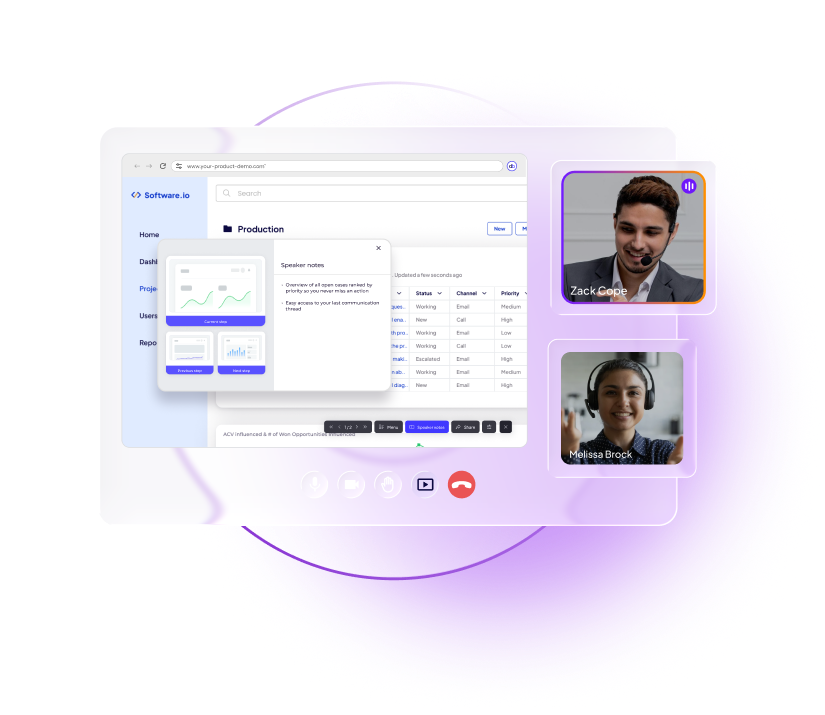
Demoboost Implementation:
Configure custom screen layouts for projection | Enable Autoplay for narrated portions
4. Post-Event Lead Nurturing
The event demo experience should continue digitally after the booth closes, turning brief interactions into sustained sales conversations.
Personalized Follow-Up Strategy
Segment by engagement behavior:
- Demo path chosen (role/use case from Choose Your Own Journey)
- Engagement depth (screens viewed, time spent, completion)
- In-demo actions (CTA clicks, resource downloads)
- Lead form data (role, company, pain points)
Personalize with Variables and Video Narration:
- Company name and industry
- Specific use case explored at the booth
- Event reference and booth staff name
- Optional video intro from the booth rep to reconnect the demo with the in-person conversation
and build rapport after the event
Tier CTAs by engagement level:
High intent:
"Schedule a call with [booth rep]"
"Book a personalized demo"
Medium intent:
"Explore full demo gallery"
"Deep dive on [feature]"
"Deep dive on [feature]"
Low intent:
"Revisit booth demo"
"Share with your team"
"Share with your team"
Sync Demo Engagement with Lead Scoring
Feed booth demo behavior into CRM to prioritize post-event outreach:
High-value signals (+high score):
- Demo completion
- High-value use case selection
- "Talk to Sales" clicks
- 3+ minutes engagement
- Internal sharing
Medium-value signals (+moderate score):
- 50%+ completion
- Lead form submitted
- Educational CTA clicks
Route leads by tier:
- Tier 1 (24hr): Completed demo + "Talk to Sales" + target accounts
- Tier 2 (48-72hr): Medium+ engagement + high-value persona
- Tier 3 (nurture): Started demo or minimal engagement
Activate sales with real-time alerts:
Demo completion within 24hrs | "Book Meeting" clicks | Internal sharing
Demoboost Implementation:
Map demo actions to CRM lead scoring | Configure custom ending screens with tiered CTAs | Set up CRM sync and real-time alerts | Create automated nurture sequences by engagement level
Try Our Add-Ons to increase your demos’ engagement and interactivity.
5. Best Practices
Prioritize Lead Capture
Events are about collecting contact information. Use strategic lead form placement—don't gate so early that no one engages, but don't wait so late that you miss drop-offs.
Design for Interruption
Demos must deliver value in 30-60 seconds. Lead with outcomes, not setup.
Enable Self-Identification at Scale
Self-guided demos let visitors tell you who they are on their own terms—critical when you can't personally engage everyone.
Standardize Booth Narratives
Equip all staff with the same demo library and speaker notes for consistent messaging.
6. Role in the Buyer Journey
At the Awareness stage, event and trade show demos:
- Replace static booth pitches with hands-on product experiences
- Turn foot traffic into qualified leads through strategic lead capture and engagement tracking
- Bridge physical and digital touchpoints, extending event conversations into ongoing sales cycles
- Enable asynchronous buying committee engagement by giving attendees shareable assets they can distribute internally
Event demos shift the booth conversation from "tell me about your product" to "show me how it solves my specific problem."
7. Success Metrics (event-specific patterns)
On-Site Engagement:
- Booth demo participation rate: 25-45% of badge scans
- Self-serve completion rate: 30-50%
- Average screens viewed per session: 3-6
- Top use case selections (for segmentation)
Lead Quality:
- Lead-to-MQL uplift: +15-30% vs. non-demo event leads
- Meeting request rate from demo-engaged attendees
- Demo engagement depth (multiple paths, re-engagement)
Post-Event Activation:
- Follow-up demo open rate: 30-40%+
- Follow-up demo completion rate: 25-40%
- Time to first sales conversation (demo-engaged vs. not)
Pipeline impact
- Event leads → opportunities (demo-engaged vs. not)
- Win rate for opportunities with event demo touchpoints
Demoboost Analytics connects booth engagement, demo behavior, and post-event activity to CRM outcomes for end-to-end visibility
8. Common Pitfalls to Avoid
- Demos too long for booth context – Walk-up audiences behave differently than website visitors.
- Gating too early – Prevents prospects from seeing enough value to justify sharing their details.
- Gating too late – Events are high-intent moments; failing to capture leads wastes qualified interest.
- No pre-event priming – Demos sent before the event increase booth efficiency and conversation quality.
- Generic follow-ups – Ignoring what attendees explored wastes the strongest intent signal.
- Relying on live product – Connectivity and login failures frequently derail event demos.
- No internal sharing path – Buyers often need to circulate what they saw internally after the event.
- Inconsistent booth narrative – Misaligned rep messaging weakens positioning and recall.
Try Our Add-Ons to increase your demos’ engagement and interactivity.